
The meeting that could have split the church in two ends with a quotation from Amos.
Jerusalem, sometime around the middle of the first century. The question on the table is about as explosive as questions get. Gentiles, non-Jews, have been turning to Jesus in the cities Paul and Barnabas visited, and some believers from Judea have been telling them, “Unless you are circumcised according to the custom of Moses, you cannot be saved” (Acts 15:1). Believers from the Pharisees’ party press it at the meeting itself: “It is necessary to circumcise them and to order them to keep the law of Moses” (15:5).
In other words: to belong to Israel’s Messiah, you have to become Israel first.
There’s “much debate” (15:7). Peter speaks. Barnabas and Paul tell what God has been doing among the Gentiles. And then James, the brother of Jesus, the leader of the Jerusalem church, stands up to settle it. He doesn’t settle it with a policy. He settles it with a prophecy about David’s house.
16 “‘After this I will return, and I will rebuild the tent of David that has fallen; I will rebuild its ruins, and I will restore it, 17 that the remnant of mankind may seek the Lord, and all the Gentiles who are called by my name, says the Lord, who makes these things 18 known from of old.’” (Acts 15:16–18)
To understand why that verse ends the argument, you have to go back a thousand years, to a promise, and then forward a few centuries, to a ruin.
A house that fell into a hut
In 2 Samuel 7, God makes King David the most astonishing promise in the Old Testament story of the kings. David had wanted to build God a house, a temple. God turns it around: You won’t build Me a house. I’ll make you one. A dynasty. “Your house and your kingdom shall be made sure forever before me. Your throne shall be established forever” (7:16).
Forever.
And then history happened. The kingdom split in two after Solomon. The northern kingdom fell to Assyria. The southern kingdom, David’s own, limped on under his descendants until 587 BC, when Babylon burned Jerusalem and carried the last king away. John Goldingay says it bluntly: after 587, “no Davidic king ever sat on the throne of Jerusalem.” The promise, he adds, “kept Israel hoping, and it kept Israel praying.”1
That’s the ache that sits underneath the last verses of Amos.
Amos was a shepherd from Tekoa (Amos 1:1), a man, in his own words, the LORD “took… from following the flock” (7:15). In Hebrew that’s nearly the same phrase God used of David in 2 Samuel 7:8: “I took you from the pasture, from following the sheep.” A shepherd-prophet, talking about the house of the shepherd-king. Most of his book is judgment, and it’s relentless. But at the very end the tone turns, and this is what he says:
11 “In that day I will raise up the booth of David that is fallen and repair its breaches, and raise up its ruins and rebuild it as in the days of old, 12 that they may possess the remnant of Edom and all the nations who are called by my name,” declares the LORD who does this. (Amos 9:11–12)
(Whether Amos himself spoke those closing verses, or whether they were added after Jerusalem fell, is one of the long-running debates about the book. Either way, the picture is of a house that has come down.)
Look at the noun.
Booth — סֻכָּה — sukkâ — thicket; booth, hut; a temporary shelter of branches (BDB).
It’s the word for the shelters Israel built every autumn at the Feast of Booths, Sukkot: flimsy things of branches you live in for a week and take down. David’s house, the bayit God promised would stand forever, is now called a sukkâ. A hut. And it’s fallen over.
That’s a different word from the one Isaiah uses when he imagines a future king “in the tent of David” (Isaiah 16:5). Isaiah says ʾōhel, tent. Amos says sukkâ, booth. Two prophets, two nouns, the same dynasty. For Amos it’s not even a tent anymore.
And yet listen to Amos’s verbs in Hebrew, because they’re 2 Samuel 7’s verbs. “I will raise up,” ʾāqîm, is the same verb as “I will raise up your offspring after you” (2 Samuel 7:12). “Rebuild it,” ûbnîtîhā, is the building verb of 7:13. “As in the days of old,” kîmê ʿôlām, uses the word that 7:13 and 7:16 translate “forever.” I can’t prove Amos meant to echo the chapter. But if you know 2 Samuel 7 in Hebrew, you can’t read Amos 9:11 without hearing it. The ruin is described in the promise’s own vocabulary. God will raise up again what He said He’d raise up the first time.
One letter and one vowel
Now put Amos 9:12 next to what James quotes, and something jumps out.
Amos, in the Hebrew: “that they may possess the remnant of Edom.”
James, in Acts: “that the remnant of mankind may seek the Lord.”
James (or Luke, reporting him) is quoting Amos in the Septuagint, the Greek translation of the Hebrew Scriptures that Greek-speaking Jews across the Mediterranean read, and that the early church used as its Bible. And the Greek of Amos 9:12 reads the Hebrew differently in two places.
Possess — יָרַשׁ — yāraš — to take possession of, inherit; to dispossess (BDB). Seek — דָּרַשׁ — dāraš — to seek, inquire of, consult; to seek God (BDB).
In Hebrew consonants, “they will possess” is יירשו and “they will seek” is ידרשו. That’s one letter’s difference.
“Edom” is אדום. “Humanity,” ʾādām, is אדם. That’s one vowel letter’s difference.
So either the Greek translators had a Hebrew text that read seek and humanity, or they read the letters in front of them that way. Scholars still argue about which. That question’s open. But the result is the same. What the traditional Hebrew text reads as Israel will take Edom, the Bible the apostles read has as humanity will seek, and Acts supplies the Lord. And James stands up in Jerusalem and says: that’s what’s happening. Right now. That’s the Gentiles in Antioch.
There’s one more small detail worth noticing. The traditional Hebrew text doesn’t just say “Edom.” It puts the object marker in front of it, ʾet-šĕʾērît ʾĕdôm, “the remnant of Edom,” as the thing possessed. In the Greek, “the remnant” isn’t the thing conquered anymore. It’s the subject of the sentence. The people who were going to be taken are now the ones doing the seeking.
The verb that isn’t in Amos
Now here’s where it gets good. I’ll be careful, because this is an observation about words, not something I can prove about anybody’s intentions.
Look again at the end of Acts 15:16: “I will rebuild its ruins, and I will restore it.”
That last verb isn’t in Greek Amos. Where James has “I will restore it,” the Septuagint of Amos says again “I will raise up… and I will rebuild.” The word James uses is different.
Restore — ἀνορθόω — anorthoō — to build anew, restore; to set upright, straighten (BDAG).
And that verb is in 2 Samuel 7, in Greek. It’s the word the Septuagint uses for God establishing the son’s throne: “I will establish his throne forever” (2 Samuel 7:13), and “his throne shall be established forever” (7:16; the Hebrew reads your throne). In the Greek Bible that’s anorthoō: set upright, stand it back up.
So when James finishes the quotation from Amos, the word he lands on is the throne-word of 2 Samuel 7. Did he mean it? I don’t know. Did Luke, writing it down? I don’t know that either. But anybody who knows their Greek Bible and reads Luke’s account hears David’s throne in the last verb of Amos’s rebuilt tent.
It’s a rare word. It shows up only three times in the whole New Testament: here; in Hebrews 12:12 (“lift your drooping hands”); and in Luke 13:13, where Jesus lays His hands on a woman who has been bent over for eighteen years and “immediately she was made straight.” Two of the three are Luke’s. A bent-over woman stood upright, and a fallen house of David stood upright. Same word. I love that.
(While we’re in 2 Samuel 7, there’s one more tantalizing neighbor. In 7:19, David, overwhelmed by the promise, says something the translators have never quite agreed on: wĕzōʾt tôrat hāʾādām, which the ESV renders “and this is instruction for mankind.” That’s ʾādām again, humanity, the same word Greek Amos reads in 9:12. Some interpreters hear David glimpsing that the promise to his house will reach the whole human race. Harry Hoffner, who is sympathetic to that reading, is also honest about it: whether careful exegesis of the phrase yields it “remains to be seen.”2 I’d hold it lightly. The reading of Acts 15 doesn’t depend on it at all. But it’s there.)
Jewish before it was Christian
It would be easy to assume James was doing something new here, taking a Jewish promise about a Jewish king and bending it toward Gentiles. But he wasn’t the first to put these two texts together. Not even close.
Among the Dead Sea Scrolls, found in caves near Qumran by the Dead Sea and copied before the church existed, there’s a short text scholars call 4Q174, or the Florilegium: a collection of Scripture passages, each followed by its interpretation. One of those passages is 2 Samuel 7:10–14, the heart of the promise: I will raise up your offspring after you… I will establish the throne of his kingdom forever. I will be a father to him, and he shall be a son to me.
The scroll’s interpreter says the “offspring” is the Branch of David, a messianic figure who will arise, alongside an Interpreter of the Law, in Zion at the end of days. And then, to support it, he quotes a second text: I will raise up the booth of David that is fallen. Amos 9:11. The fallen booth, he says, is the one who will arise to save Israel.3
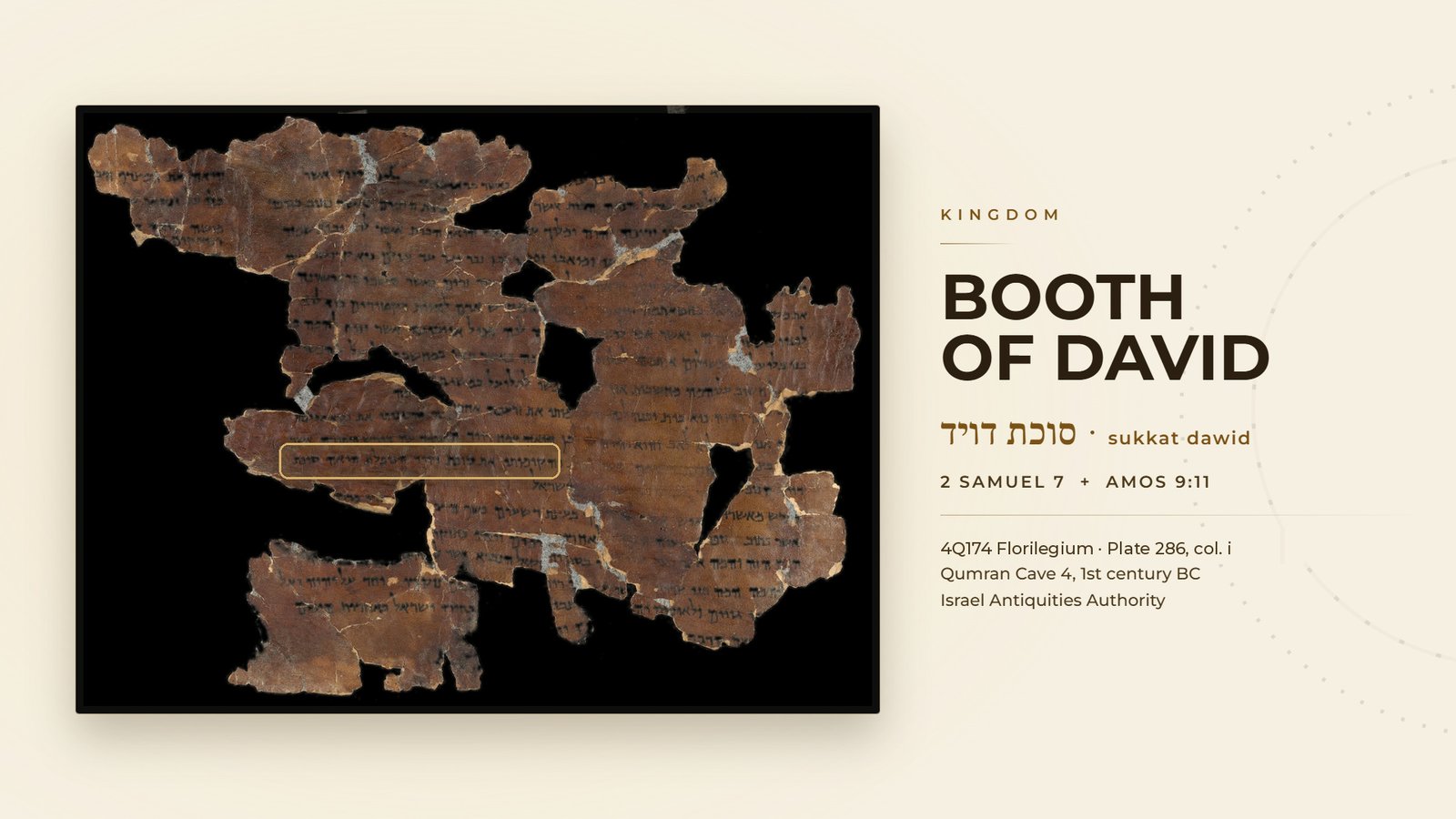
So the pairing you find in Acts 15, 2 Samuel 7 and Amos 9 read together, and read about a coming son of David, was already sitting on a shelf in a Jewish library before anyone had heard of the church. James didn’t invent the connection. He used one his world already knew. What was new was what he said it meant: the booth had been raised, and the proof was Gentiles seeking the Lord.
And the Qumran community didn’t read Amos 9:11 only one way, either. Another of its texts, the Damascus Document, quotes the same verse and interprets the fallen booth of David as the books of the Law.4 One community’s library holds two different readings of the same line. It’s one more reminder that this verse was argued over long before James stood up.
Sure mercies, for everyone
There’s one more piece, and it’s the one that shows how far the promise was always meant to travel.
In 2 Samuel 7, God’s promise to David’s son rests on two words: “my steadfast love will not depart from him” (7:15), and “your house… shall be made sure” (7:16). Ḥesed and ʾāman.
Steadfast love — חֶסֶד — ḥesed — covenant loyalty, steadfast lovingkindness (HALOT).
Isaiah takes those two words and does something startling with them:
3 Incline your ear, and come to me; hear, that your soul may live; and I will make with you an everlasting covenant, my steadfast, sure love for David. (Isaiah 55:3)
In Hebrew that’s ḥasdê dāwid hanneʾĕmānîm, “the sure steadfast loves of David.” Ḥesed from 7:15, ʾāman from 7:16. What a promise. And the “you” is plural. The whole people. God takes the promise that was made to one king’s house and extends it to everyone who will “incline your ear and come.” Goldingay again: God sometimes “encouraged [Israel] to see itself as the Davidic people and to see God’s commitment fulfilled in the relationship all the people had with God.”5
Paul picks this very verse up in a synagogue in Pisidian Antioch and applies it to the resurrection: “And as for the fact that he raised him from the dead, no more to return to corruption, he has spoken in this way, ‘I will give you the holy and sure blessings of David’” (Acts 13:34). I will give you, plural. The sure mercies promised to David are handed out, through the risen Son of David, to a whole roomful of listeners, “men of Israel and you who fear God” together (13:16, 26).
That’s the arc. A promise to one man’s house. A house that falls into a hut. A hut God swears to raise. And when He raises it, the doors turn out to be open to the whole human race.
So who is the house for?
James’s verdict, after the quotation: “Therefore my judgment is that we should not trouble those of the Gentiles who turn to God” (Acts 15:19). He asks the Gentile believers to steer clear of a few practices that would make table fellowship with Jewish believers impossible (15:20). But the big question is closed. They don’t have to become Jews to belong. The house was rebuilt so that the remnant of humanity could seek the Lord.
Just before he quotes Amos, James sums up what Peter reported: “God first visited the Gentiles, to take from them a people for his name” (15:14). A people for his name. Not a people for our culture, or our comfort, or our way of doing things. For his name.
I think that question lands on every church sooner or later, and on ours too. What do we quietly require people to become before they really belong? Not circumcision, probably. But a certain income. A certain politics. A certain way of dressing, talking, parenting, voting, a certain story that looks like ours. We’d never write it down. We’d never say it out loud. But people can feel the circumcision requirement long before anybody mentions it.
The tent of David wasn’t rebuilt for us to guard the door. It was rebuilt so the rest of humanity could walk in looking for God.
And here’s how the story ends. God once told David, “I have not lived in a house… but I have been moving about in a tent for my dwelling” (2 Samuel 7:6). God chose a tent. David’s house fell into a booth. God swore to raise it. And on the last pages of the Bible, a voice from the throne says this:
3 “Behold, the dwelling place of God is with man. He will dwell with them, and they will be his people, and God himself will be with them as their God.” (Revelation 21:3)
In Greek: hē skēnē tou theou meta tōn anthrōpōn. The tent of God is with humanity. The same two words: skēnē, the tent James quoted, and anthrōpōn, the humanity Amos’s Greek said would come seeking.
The fallen tent, rebuilt. And everybody’s invited in.
Notes
Footnotes
-
John Goldingay, 1 and 2 Samuel for Everyone (Louisville: Westminster John Knox, 2011), 132–136, on 2 Sam 7. ↩
-
Harry A. Hoffner Jr., 1 & 2 Samuel, Evangelical Exegetical Commentary (Bellingham, WA: Lexham Press, 2015), 2:298–335, on 2 Sam 7:19. ↩
-
4Q174 (4QFlorilegium) frags. 1–3 col. i. For text and translation see Florentino García Martínez and Eibert J. C. Tigchelaar, eds., The Dead Sea Scrolls Study Edition, 2 vols. (Leiden: Brill; Grand Rapids: Eerdmans, 1997–1998), vol. 1. The scroll is paraphrased here rather than quoted. ↩
-
Damascus Document (CD) 7.15–16; see García Martínez and Tigchelaar, Dead Sea Scrolls Study Edition, vol. 1. ↩
-
Goldingay, 1 and 2 Samuel for Everyone, on 2 Sam 7, citing Isaiah 55. ↩